
Imagine you are sitting across from your doctor after weeks of worrying about your memory. You have started forgetting names, misplacing things, and asking the same questions twice. Then, your doctor mentions a new Alzheimer blood test that could help detect the disease through a simple blood draw. No lengthy scan. No complicated preparation. Just a small sample of blood.
You feel relieved. But then comes the question: “If this blood test can detect Alzheimer’s, do I still need an MRI?”
It is a fair question and one that is becoming increasingly important as blood tests for Alzheimer’s biomarkers continue to advance. From the promising p-tau217 blood test to the growing role of brain imaging, researchers are changing how we understand Alzheimer’s detection.
But can blood tests replace MRI? What does a brain scan reveal that a blood test cannot? And where does volumetric MRI analysis fit into this evolving picture?
Let’s explore what each test can, and cannot tell us.
If you have been following Alzheimer’s research, you have probably heard of p-tau217.
The name sounds complicated, but the idea is straightforward. p-tau217 is a form of phosphorylated tau, a protein associated with Alzheimer’s disease. A p-tau217 blood test measures this protein in plasma.
Alzheimer’s disease involves biological changes that can begin before noticeable memory problems. Blood biomarkers may help identify evidence of Alzheimer’s-related pathology without immediately requiring an invasive or expensive investigation.
This has made the Alzheimer’s blood test an area of growing interest for earlier assessment and more accessible diagnostic pathways.
Research has shown that p-tau217 can be useful for detecting Alzheimer’s-related amyloid pathology. Some studies have compared p-tau217 with established tests such as amyloid PET and cerebrospinal fluid (CSF) biomarkers.
The results are encouraging. But accuracy is not the same for every test.
The performance of a blood test depends on the assay, the population being tested, and how the result is interpreted. This is why the question “How accurate is the p-tau217 blood test?” needs more than a single percentage as an answer.
The Alzheimer’s Association’s 2025 clinical practice guideline recommends choosing blood-based biomarker tests based on their diagnostic performance. It does not endorse every commercially available test.
Could an Alzheimer’s blood test predict the future in someone who feels completely healthy?
Researchers are studying this question. Some studies have explored whether blood biomarkers can help estimate the risk of future cognitive decline.
But there is a difference between detecting biological changes and predicting exactly when someone will develop memory problems.
A positive biomarker result does not mean a person will definitely develop dementia, or that symptoms will appear within a specific number of years.
For now, blood biomarker testing needs to be interpreted carefully, particularly when used outside the clinical settings for which it has been validated.
p-tau217 is not the only biomarker being studied.
Other blood tests for Alzheimer’s biomarkers include:
You may also come across the term ATN blood test for Alzheimer’s. ATN stands for Amyloid, Tau, and Neurodegeneration. It is a framework used to organize different biological features of Alzheimer’s disease.
The takeaway is simple: Alzheimer’s is a complex disease. No single marker tells the entire story.
The Alzheimer’s Association published its first clinical practice guideline for blood-based biomarkers in July 2025. The guideline focuses on patients with objective cognitive impairment who are being evaluated in specialized memory-care settings.
It provides two important recommendations:
These recommendations are about validated blood tests and specific clinical situations. They do not mean that every blood test for Alzheimer’s disease can replace every type of brain scan.
The guideline also makes an important point: blood biomarker testing should be part of a comprehensive clinical evaluation.
Think about what happens when you get a blood test.
You receive numbers that tell you something about what is happening in your body. But those numbers do not show you the shape of your brain, the size of your hippocampus, or whether another structural problem may be contributing to your symptoms.
That is the key difference in the Alzheimer’s blood test vs MRI discussion.
A blood test may help answer:
“Is Alzheimer’s-related pathology likely?”
An MRI may help answer:
“What does the brain look like, and are there structural changes that need attention?”
Both questions matter.
MRI gives doctors a view of brain anatomy.
One area of interest in Alzheimer’s disease is the hippocampus, a brain region involved in memory. Changes in hippocampal volume can be seen in some people with Alzheimer’s disease.
A hippocampal atrophy MRI can help clinicians assess these structural changes. But hippocampal atrophy is not unique to Alzheimer’s. Other conditions can also affect brain volume.
That is why MRI findings should be interpreted alongside symptoms, medical history, and other investigations.
MRI can also help identify structural conditions that may contribute to cognitive symptoms. This is something a blood test cannot do on its own.
An MRI can also provide a structural baseline.
If a patient has follow-up scans, doctors may be able to compare brain volume over time. This is where volumetric MRI analysis becomes useful.
Instead of looking only at a scan visually, volumetric analysis measures specific brain regions and helps quantify their volume. It can support the assessment of regional brain changes and longitudinal monitoring when used appropriately.
This does not mean MRI can independently diagnose or stage every case of Alzheimer’s disease. It means imaging adds structural information that blood biomarkers do not directly provide.
So, what is the difference between a blood test and an MRI when evaluating Alzheimer’s disease?
The answer is simple: they provide different types of information.
A blood test can look for biomarkers associated with Alzheimer’s disease and may help identify people who need further clinical evaluation.
An MRI, on the other hand, provides detailed images of the brain. It can help doctors assess brain structure, look for patterns of brain changes, rule out other possible causes of symptoms, and support monitoring over time.
Think of them as two different pieces of the same clinical picture:
Blood Test → Detects Biomarkers
Clinical Assessment → Evaluates Symptoms & History
MRI → Shows Brain Structure
Follow-up → Tracks Changes Over Time
For example, a person experiencing memory problems may first undergo a clinical assessment and, where appropriate, a blood-based biomarker test. Depending on the findings and the clinical situation, the doctor may then recommend MRI, PET, CSF testing, or other investigations.
A blood test can provide information about biological markers, while MRI can provide information about brain structure and changes over time.
Rather than replacing one another, these tools can potentially complement each other as part of a broader diagnostic and monitoring pathway.
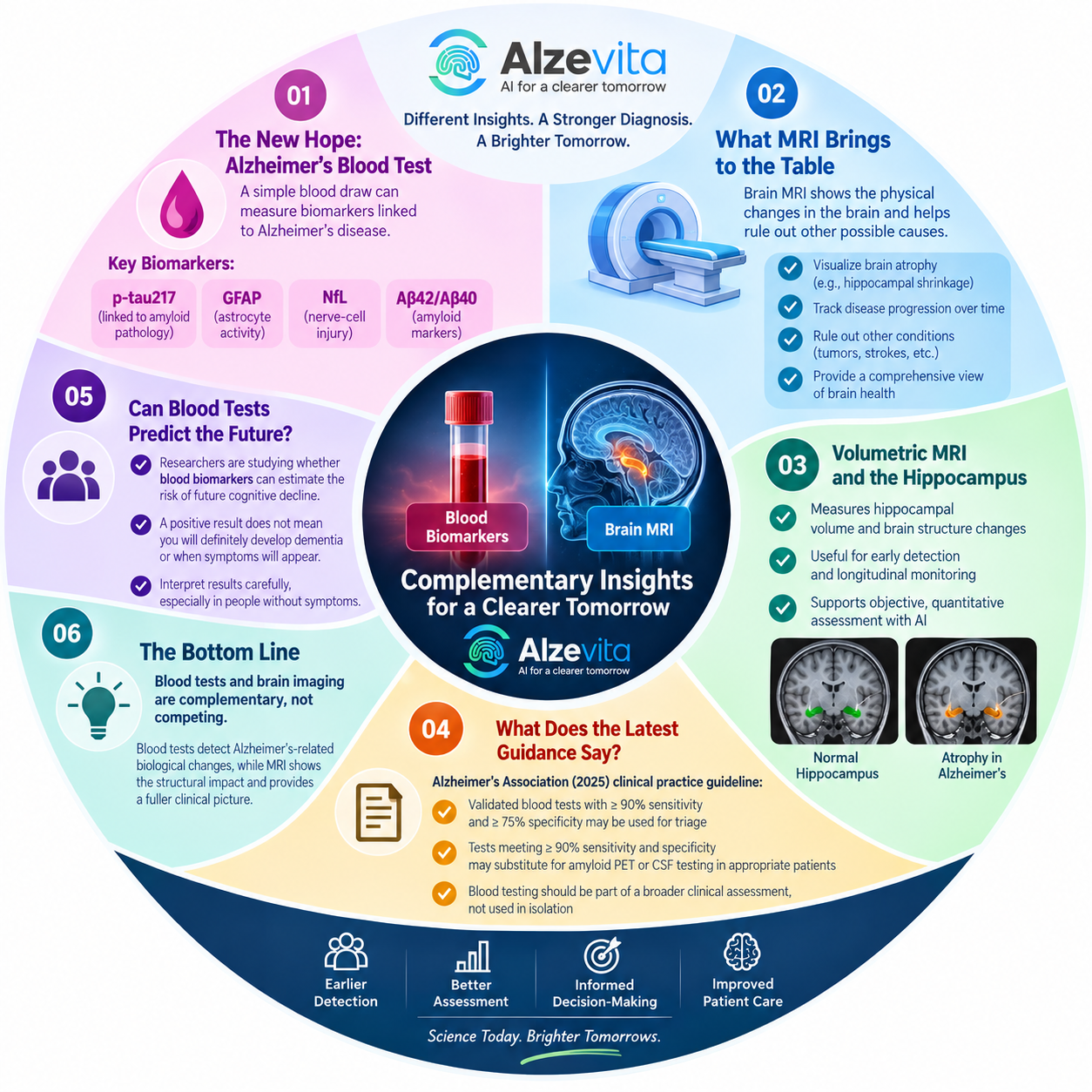
As blood-based biomarkers become more accessible, the need for efficient brain imaging analysis remains important.
Alzevita focuses on volumetric MRI analysis, helping turn brain scans into measurable information.
With AI-powered volumetric MRI analysis, clinicians and imaging teams can assess brain regions and quantify volume changes more efficiently, depending on the tool’s intended use and validation.
This is especially relevant when MRI is used to establish a structural baseline or compare scans over time.
Alzevita’s FDA 510(k) clearance is a credibility marker for its medical imaging technology. However, the clinical role of any MRI analysis tool depends on its specific cleared indication, validation, and the way it is used in practice.
The future of Alzheimer’s assessment may not be about choosing blood tests over brain scans. It may be about using both more effectively.
Blood tests can provide valuable information about Alzheimer’s-related pathology. Tests such as p-tau217 are making the field of early assessment more promising.
But an Alzheimer’s disease blood test does not show brain structure. MRI can help assess brain volume, hippocampal changes, and other structural findings that may matter during evaluation and monitoring.
The better question is not “Which test wins?”
It is:
“What information does the clinician need next?”
Blood tests can help identify when a closer look may be useful. MRI can add a view of what is happening in the brain.
Together, they can support a more informed approach to Alzheimer’s assessment.
Yes. There are blood tests for Alzheimer’s biomarkers, including p-tau217 and amyloid-beta measurements. However, dementia has multiple possible causes, and a blood test alone cannot identify the cause of every dementia case.